- Organisation
- BBC
- Team
- BBC Live, with Responsible AI
- My role
- UX lead and senior content designer
- Year
- 2025
A small label with a big question behind it
How do you tell people the BBC has used AI in its journalism, without damaging the trust that makes the BBC worth reading?
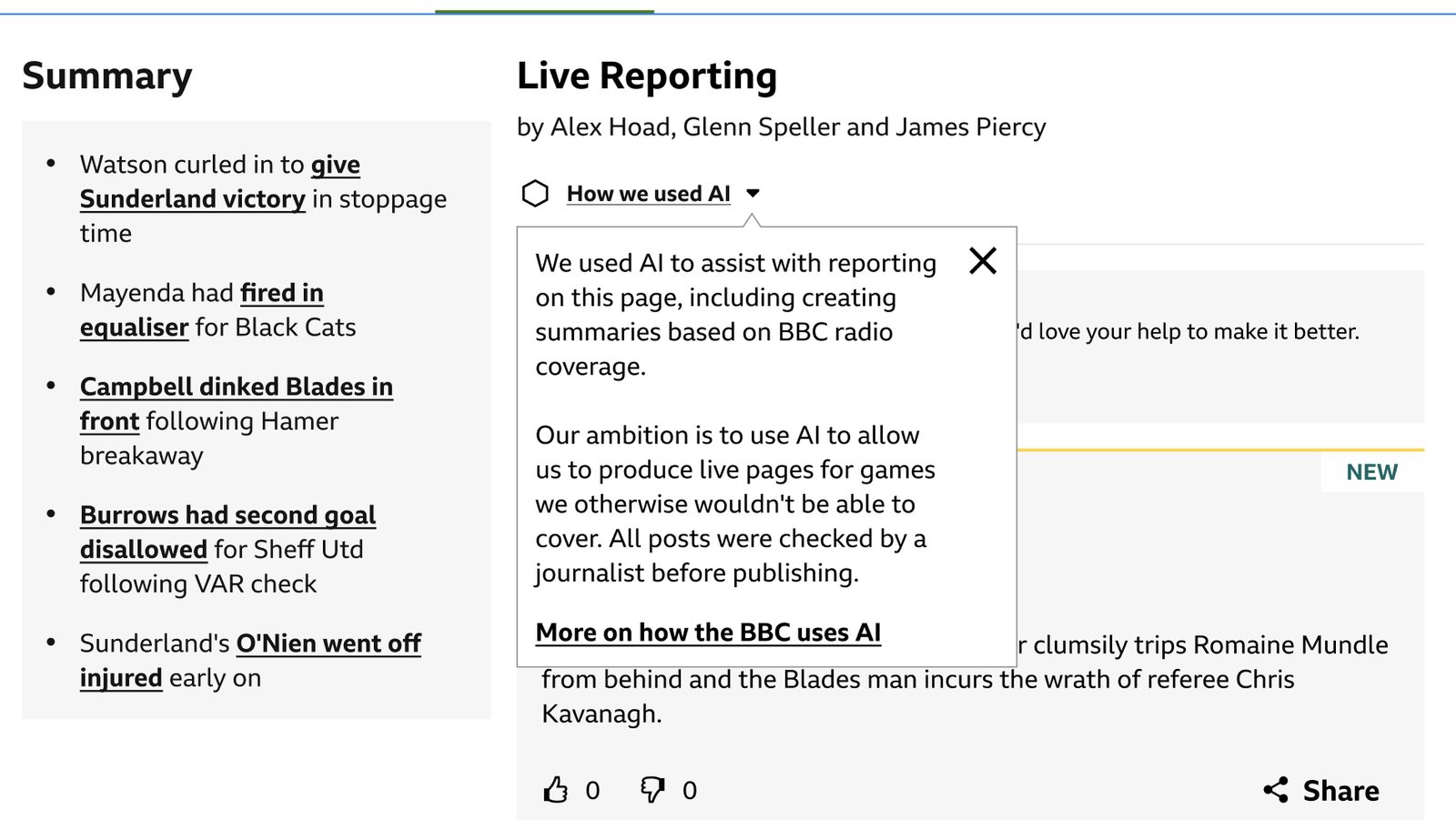
That was the question behind this trial. On BBC Sport's live football pages, AI helped turn live radio commentary into written match updates, with journalists reviewing everything before it was published. Our job was to design how we'd tell audiences that, and to find out how they felt about it.
The label itself was small. What we learned from it was meant to shape how the whole BBC talks about AI in the future.
Walking a tightrope
The trial sat where a lot of different interests met.
- Many owners: editorial, Responsible AI, brand, legal, accessibility and the design system team all had a stake, with sign-off going right to the top of the organisation.
- Everyone had an opinion on the words: a few lines of copy meant a lot of debate before we had any evidence to settle it.
- Speed versus the future: there was pressure to build something quick and simple, while Live, Research and Responsible AI each had their own goals for the trial.
- Public scrutiny: using AI in public service journalism carries real reputational risk if you get it wrong.
At one point, someone said there was a much simpler way to build this. They were right. But what would we learn?
My role
I was UX lead and senior content designer for the trial within BBC Live, leading its design, implementation and measurement. The disclosure framework itself was a collaboration with a senior content designer in the Responsible AI team.
- Content design: co-creating the content formula for AI disclosures, then putting it to work and testing it with journalists and content designers.
- UX leadership: leading the design and implementation of the trial, the research approach, the feedback mechanisms and how we'd measure success.
- Joining up the work: acting as the link between Responsible AI and the Live team, and working with the design system team to build something any team could reuse.
- Supporting the team: leaving space for a mid-level designer to own their work, and stepping in where it helped.
A formula, not just a label
Before designing anything, we looked at how AI use was already being disclosed, at the BBC and elsewhere.
Inside the BBC, it was a mixed economy. Different teams described AI in different ways, with little visibility of what anyone else was doing. Outside, most organisations used generic, broad-brush disclosures. There was an opportunity to do something more nuanced: disclosure that explains what AI actually did, in context.
So rather than write one label, my Responsible AI counterpart and I developed a formula any team could use. Each disclosure answers the same things, in the same order:
- a human-led heading: "How we used AI"
- the role of AI, in plain words, and the part people played
- somewhere to find out more: "More on how the BBC uses AI"
On the live football pages, that became a small "How we used AI" label under the byline. Opening it explained that AI helped create summaries from BBC radio coverage, why we were doing it, and that every post was checked by a journalist before publishing.
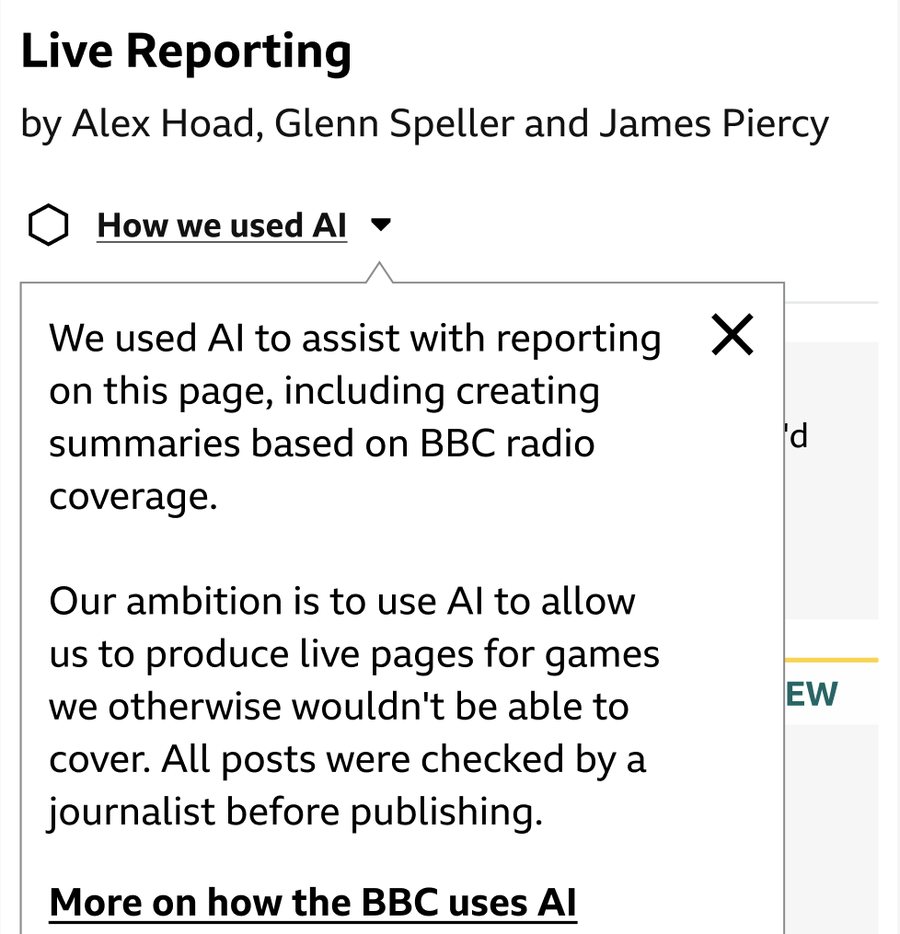
To test it, I pair-wrote with content designers and journalists, checking the formula held up across very different kinds of content. The thinking behind the wider framework is set out by the BBC in How we're designing user-centred AI labels.
Building it for the future
There was a real temptation to build the disclosure quickly, outside the BBC's design system. It would have been faster. But it would have left us with a one-off, and the whole point of the trial was to learn something the rest of the BBC could use.
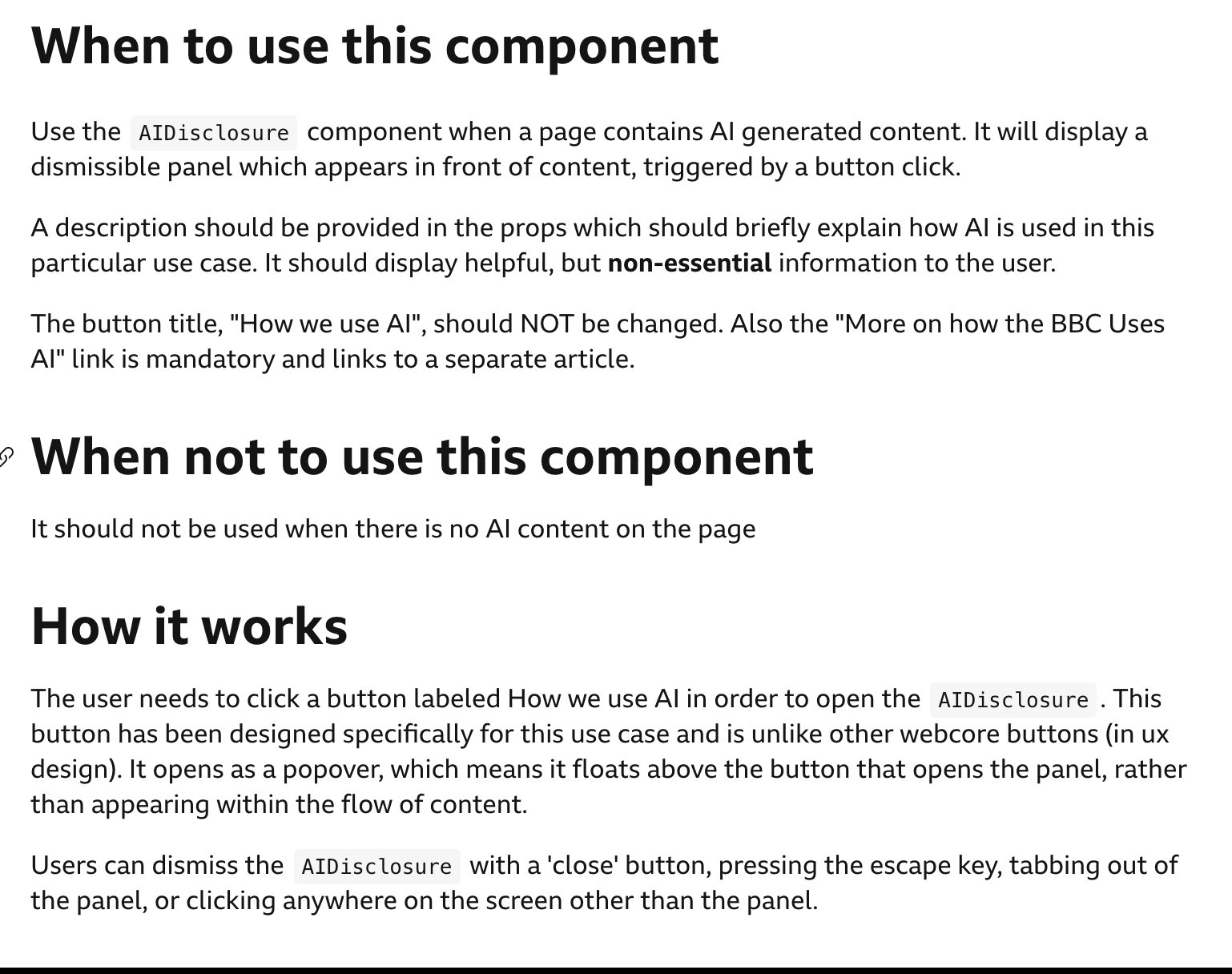
I pushed for building it properly, and took responsibility for that decision. Working with the WebCore design system team, we built a scalable, customisable component that any team can use, with usage guidance alongside it. Editorial teams can switch it on and off themselves, so future AI-assisted reporting doesn't need a designer or developer every time.
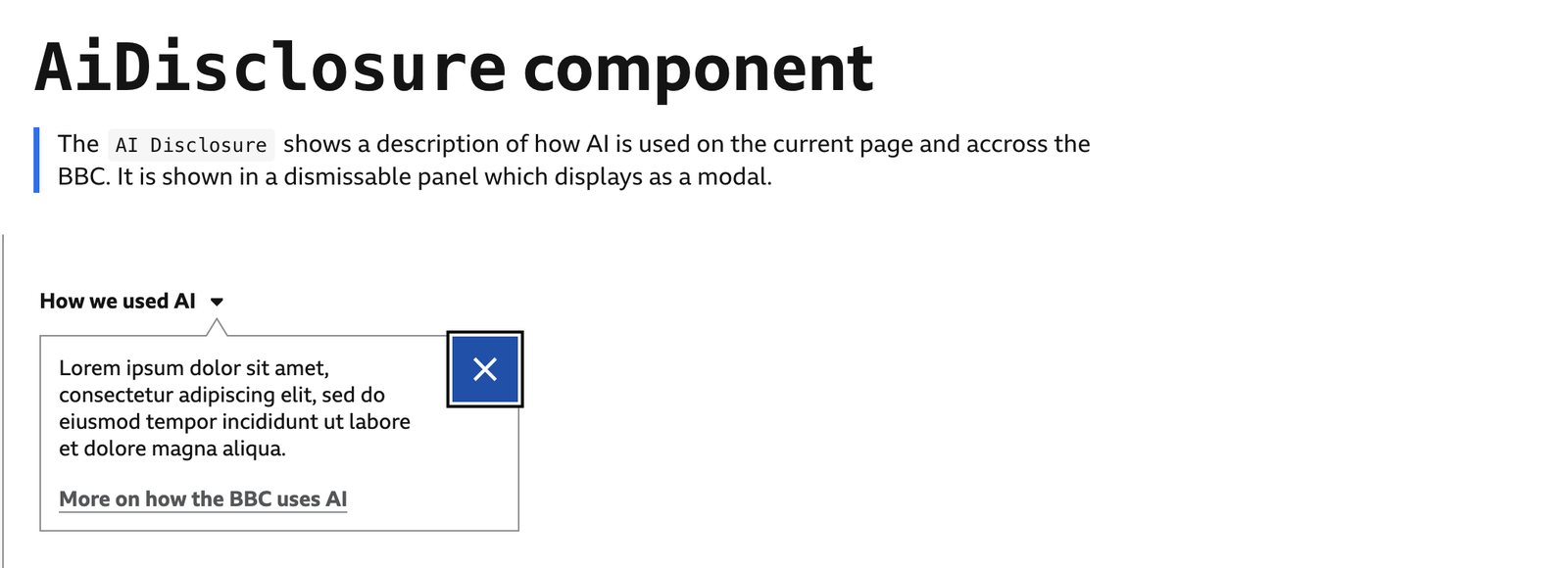
The guidance protects the formula too. The "How we used AI" button text can't be changed, and the link to more on how the BBC uses AI is mandatory, so every team that uses the component discloses AI in the same, recognisable way.
Learning as much as we could
Because this was a trial, what we learned mattered as much as what we shipped. Getting good insight meant answering a tricky question: how do you separate understanding the label from feelings about AI?
That shaped two decisions:
- low-effort reactions first: a long survey risked biasing the results, so we built a lightweight, inline way to react to the feature, using our existing analytics tooling in a new way. It was a first for the BBC.
- deeper feedback for those who wanted to give it: an onward survey, co-created with research, for people happy to tell us more.
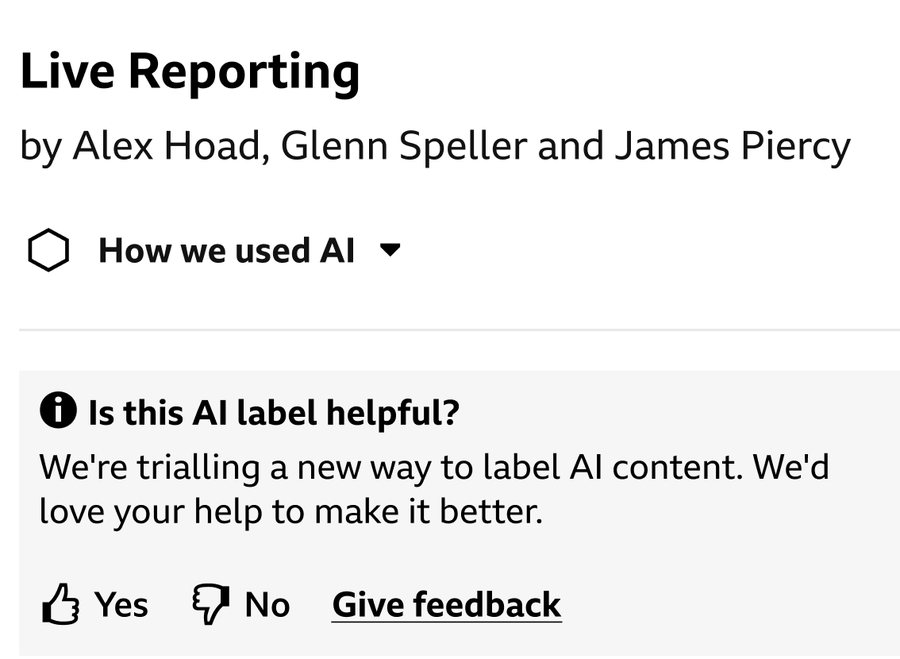
We also agreed what success meant from the start, because different teams needed different things from the trial:
- do people see and understand the label?
- does the AI tooling improve editorial workflows and help us cover more events?
- do we deliver on time, when there were other priorities?
- have we built something other teams can easily reuse?
- do we help the BBC make an informed choice about AI reporting in future?
What the trial delivered
The trial ran across 6 football matches and gave the BBC real evidence, not just opinions:
- 100,000+ impressions
- 3,500+ reactions
- 1,150+ survey responses
It left behind more than results. The disclosure component and the feedback reactions are both reusable, so other teams can disclose AI and measure the response to new features in the same way. And it built confidence in AI tooling, among stakeholders and audiences alike.
What I learned
People didn't just tell us whether they understood the label. They told us how they felt about AI being there at all. With AI, comprehension and sentiment are even harder to pull apart than usual, and next time I'd plan for that with more detailed qualitative research or more specific survey questions.
It was also a lesson in content ownership. When everyone owns the words, a formula is only as strong as the people looking after it, and keeping it intact all the way through the trial was harder than writing it in the first place.