- Organisation
- BBC
- Team
- BBC Sport
- My role
- Content designer and content strategy lead
- Year
- 2021
- In a word
- Pragmatism
The people who'd already said no
People had been able to use BBC apps without an account since they launched. That was about to change. To make the BBC Sport app more personal and relevant, everyone would soon need to sign in.
By then, the people still signed out weren't casual visitors. They were some of the app's most engaged users. They'd also seen sign-in banners almost every day for a long time, and dismissed every one.
So the question wasn't really "how do we ask people to sign in?" It was "how do we ask people who've already said no, without losing them, or damaging the app's reputation and performance?"
My role
I developed the content strategy for the move to mandatory sign-in: the research behind it, who we were talking to, what we'd say to them and when, and how we'd write it.
Learning from those who'd done it before
The BBC had been here before. Other apps, including iPlayer Radio, had already made the same move, so I started with what they'd learned.
Analysing data and research from those migrations showed a couple of things clearly:
- the last few days are make or break: if someone has ignored every message until the end, you can't persuade them. The best thing you can do is give them the quickest possible route to sign in
- not everyone resists for the same reason
That last point shaped everything. Using what we knew from iPlayer, I broke the remaining signed-out audience into groups based on why they hadn't signed in yet: people who'd do it as soon as they were asked, people who'd do it once it was required, people who needed to see the value of an account first, and a small group likely to resist until the very end.
It meant we could link the strategy to people's needs and motivations, rather than arbitrary dates. I also forecast optimistic and pessimistic outcomes and presented them to senior stakeholders, so everyone went in knowing what good, and bad, might look like.
Seven messages, seven jobs
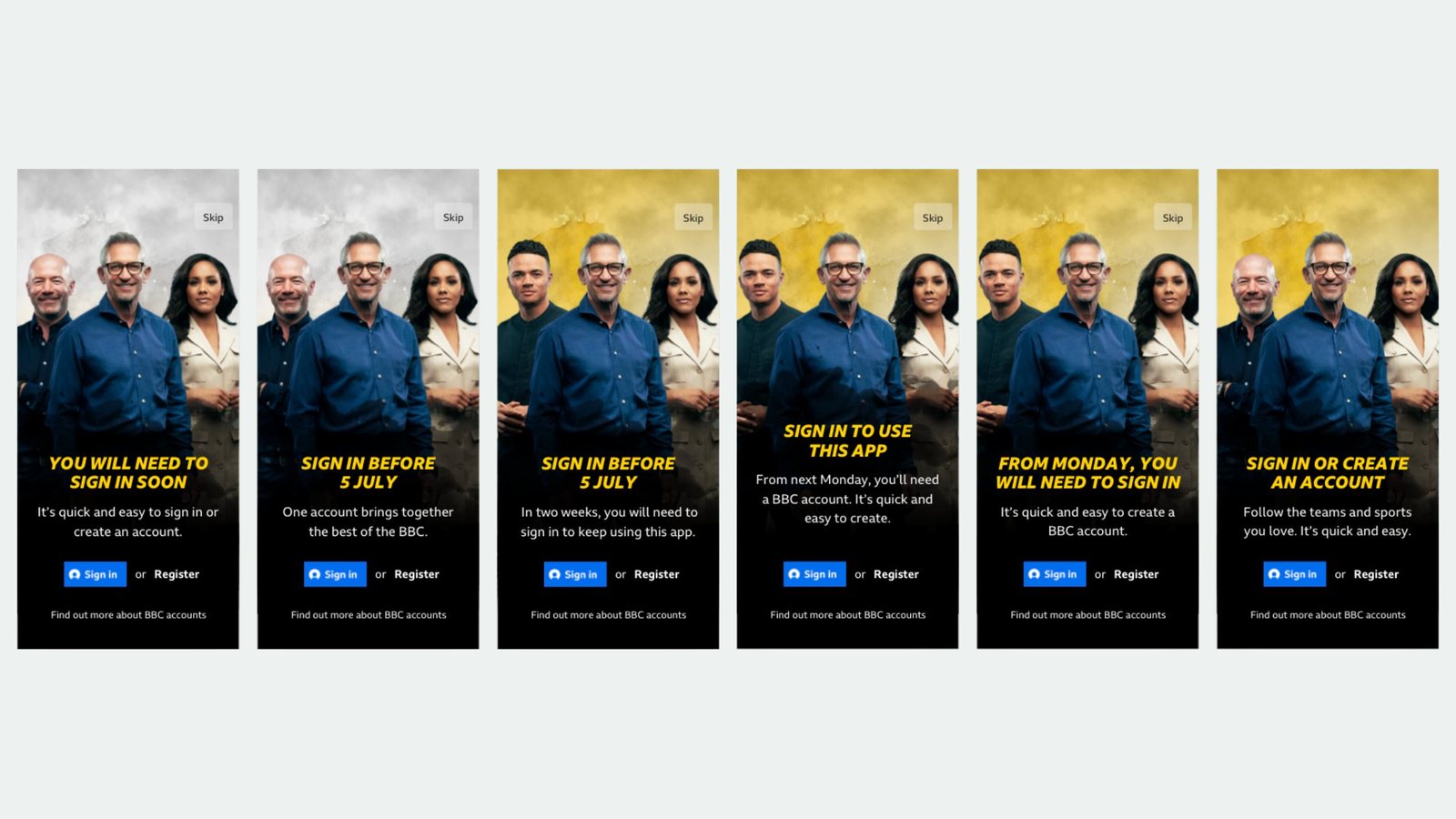
Rather than repeat one message for weeks, I designed a 7-phase messaging strategy, each phase aimed at a different motivation:
- "You will need to sign in soon": reassuring early movers that it's quick and easy
- "You will need to sign in soon": reminding people that an existing BBC account already works
- "Sign in before 5 July": a clear deadline, and the value of one account across the BBC
- "Sign in before 5 July": "in two weeks", for people motivated by a looming deadline
- "Sign in to use this app": sounding more mandatory, and focusing on how quick it is to create an account
- "From Monday, you will need to sign in": the last weekend, for anyone left
- "Sign in or create a BBC account": a respectful ultimatum, bringing back the value of an account, without dwelling on the change in a way that might alienate people
Each phase also came with a question: what can we learn at this stage? That gave us room to flex the plan if things changed, or weren't going as expected.
The early phases deliberately avoided a date. Stakeholders needed the flexibility to change plans if something went wrong, and users needed clear expectations. Starting with "soon" and introducing a fixed date once it was certain gave us both.
Why "5 July" beat "three weeks to go"
Early concepts leaned on countdowns: "July", "three weeks to go", "next week". They're punchy, but I made the case for fixed dates instead.
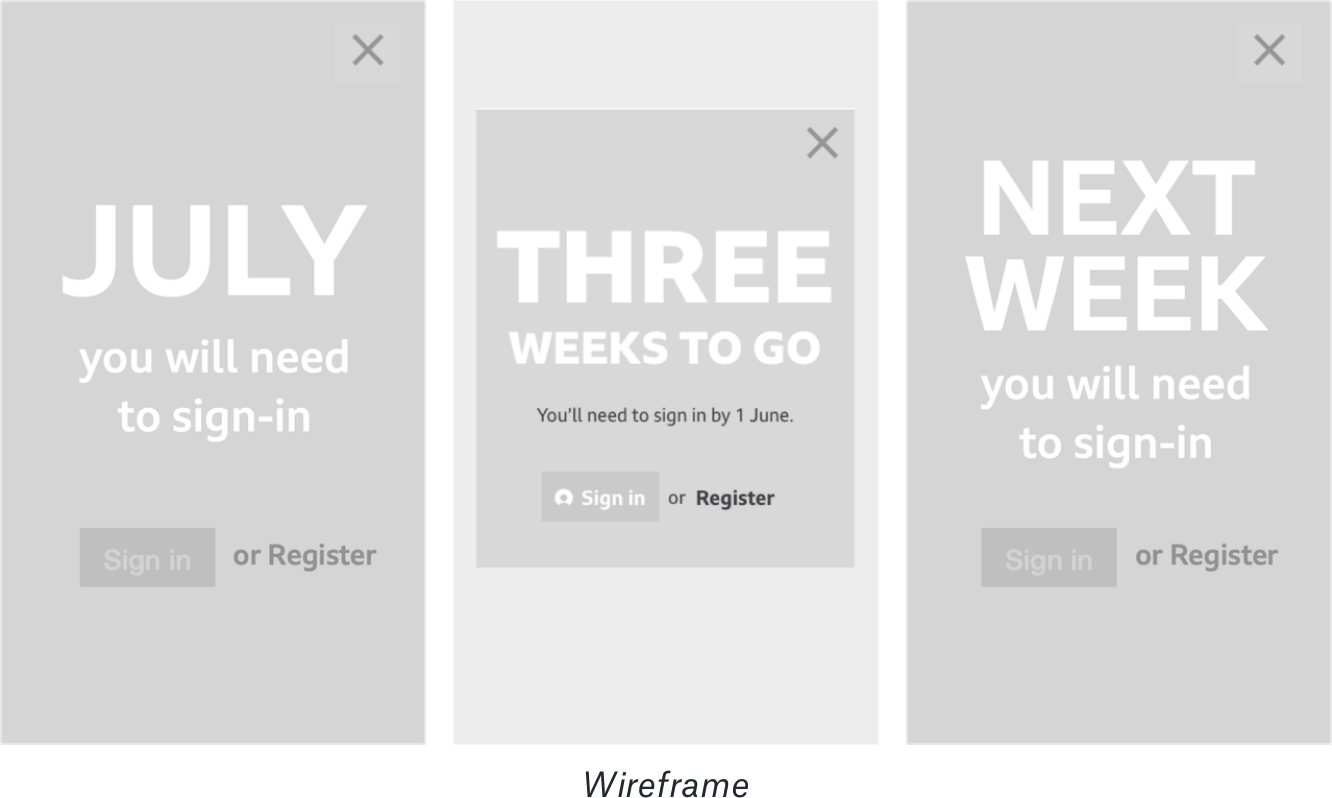
Countdowns like "three weeks to go" cause problems:
- they go out of date: the longer a message stays up, the less accurate it becomes
- they're ambiguous: three weeks until what? People skim, so crucial information has to be explicit and upfront
- they add mental load: as soon as people have to work out the deadline for themselves, you lose some of their attention
The same goes for event-based deadlines like "sign in before Euro 2020". Not everyone knows when the Euros start, and fewer could name the exact date.
Fixed dates, written following GOV.UK style, without "th" or "st", are clearer for everyone, including people whose first language isn't English and people with dyslexia. Contextual dates still have a place, but only when they're clearly timestamped or always up to date, like a live countdown clock.
The outcome
Over six weeks, the sign-in rate reached 97%, with no drop in users or app store ratings. The remaining 3% were likely to be mostly inactive users and installs.
What we learned went on to shape sign-in experiences across the BBC.
What I learned
When someone has ignored you for a year, one more persuasive banner won't change their mind. Understanding why they've said no, being honest about what's changing and making the next step as easy as possible will.