- Organisation
- BBC
- Team
- BBC Sport and Live UX
- My role
- Lead content designer and design lead
- Year
- 2026
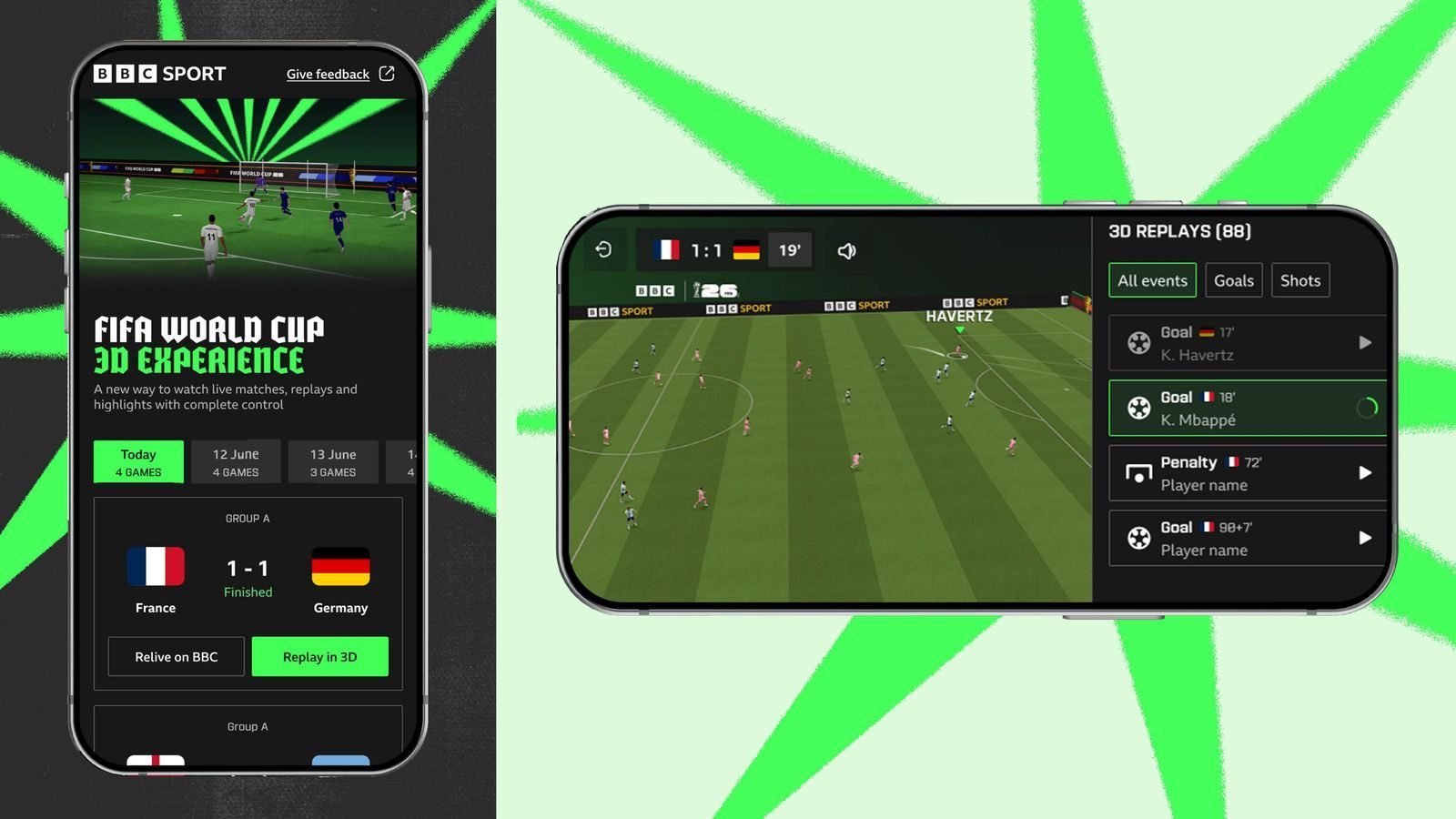
Watch the match from anywhere on the pitch
What if you could watch a World Cup match from the striker's point of view? Or swing the camera round to see exactly where the defence went wrong?
Cameras around each stadium track every player. That data is rebuilt in the cloud as an interactive 3D match that runs in the browser. Fans choose how to see it: through a player's eyes, with a free camera, or from a tactical view with the stats alongside. Live, or afterwards.
Traditional coverage lets you watch. This let people explore the match for themselves.
A beta, in front of millions
The ambition was big, and so was the stage. This was experimental technology, launching as a beta during the biggest tournament in world football, to an audience that mostly just wanted to watch the game.
That raised hard questions:
- how do you explain something nobody has used before, in the few seconds before kick-off?
- how do you describe it without sounding like a tech demo?
- how do people even find it, when most of them are watching on TV?
And a lot of people had a stake in the answers. Broadcast, marketing, editorial and product all needed it to work for them, as well as for fans.
My role
As with the New Music Portal, I was lead content designer and the design lead for the project.
- Content design: I wrote the proposition, the interface and UI content, and the banner and promo copy that brought people in.
- Creative direction for the words: a creative proposal that set out how we'd talk about the experience, and why.
- Design leadership: a cross-platform journey map that joined up broadcast, marketing, editorial and product, and coordinating the other designers on the team.
Finding the words for something new
Every competitor seemed to reach for the same word: immersive. But most of them meant VR, headsets and dedicated hardware. Ours ran in a browser. Borrowing their language risked promising the wrong thing to the wrong people.
So the creative proposal started with the language itself. I reviewed how competitors and comparators described their experiences, then mapped the semantic field of immersion: every phrase and idea that orbits the word, from "front-row seats" and "become the director" to "next gen" and "cutting edge".
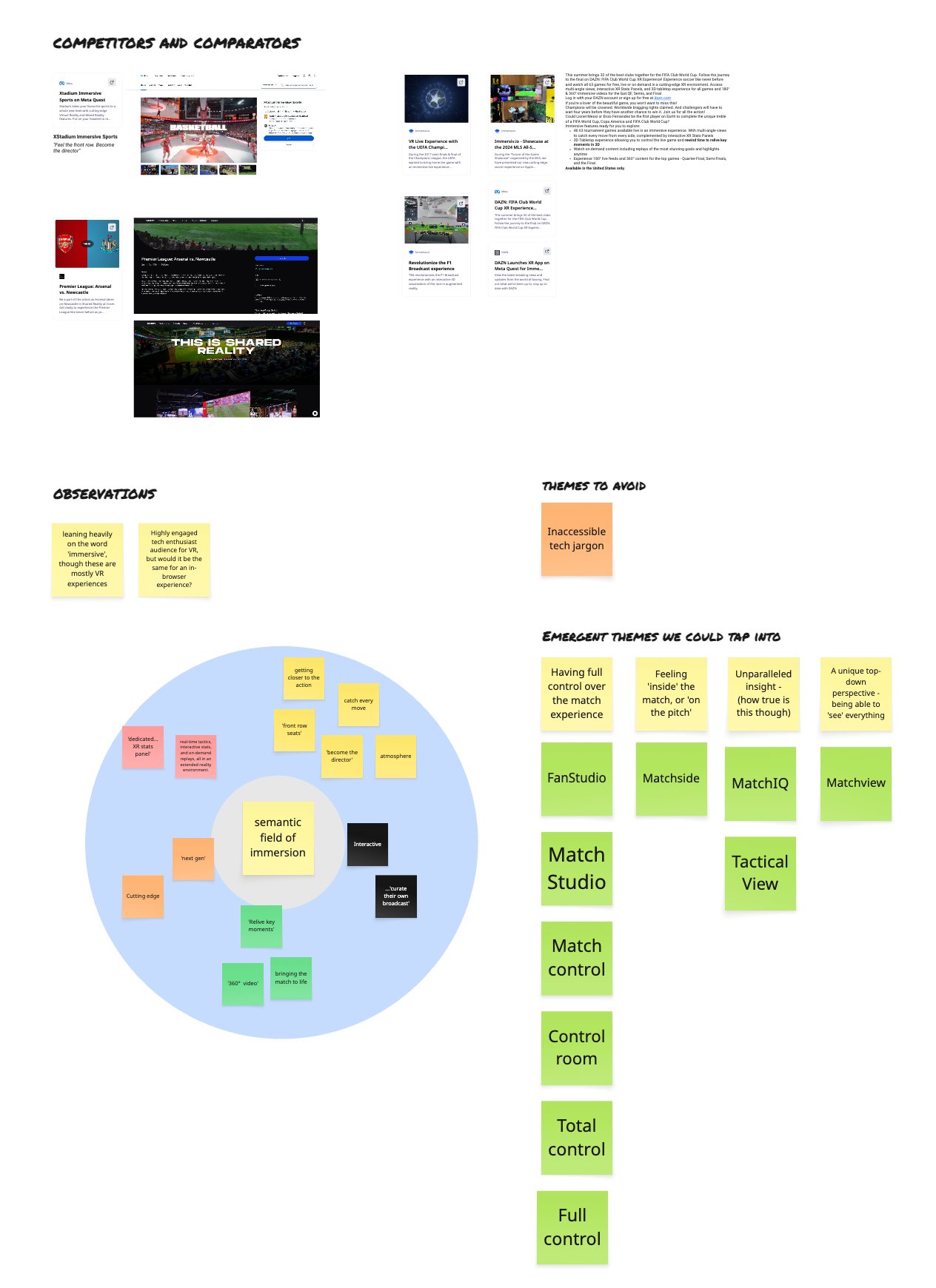
Mapping those phrases against our audience research showed which ones would land, and which to avoid. Inaccessible tech jargon was out. The idea that kept coming through was control: control of the camera, the angle and how you watch the match.
That became the heart of the proposition:
Live. Replay. Relive.
A new way to watch live matches, replays and highlights with complete control.
The proposal also gave everyone else the same words. It set out a few content levers that research suggested would resonate, for anyone writing or talking about the experience:
- Be in total control: choose the angle, relive goals as your favourite player, watch it your way
- Watch tactics unfold in real time: perspectives and tactical views you've never had before
- Side-by-side stats: live match and player data alongside the game
Internally, we summed it up in one line: it's not a replay. It's not a game. It's a deeper way to watch live football.
One journey, from the sofa to the second screen
Most fans would be watching on TV, not browsing the BBC Sport website. If the 3D experience only lived online, most people would never find it.
So I mapped the whole journey before, during and after each match, across TV and iPlayer as well as the web. It showed every moment someone might discover the experience, and what should happen next:
- before the match: a callout during the build-up, with a QR code to scan with your phone and the match hub ready while the game builds up
- during the match: a QR code and a short clip in the broadcast, launching people straight into the live game on their phone, plus links from live pages online
- after the match: a spoiler-safe match preview, so nobody gets the score ruined before they choose how to watch the replay
It also mapped other ways in: social clips, message banners, iPlayer and other BBC products.
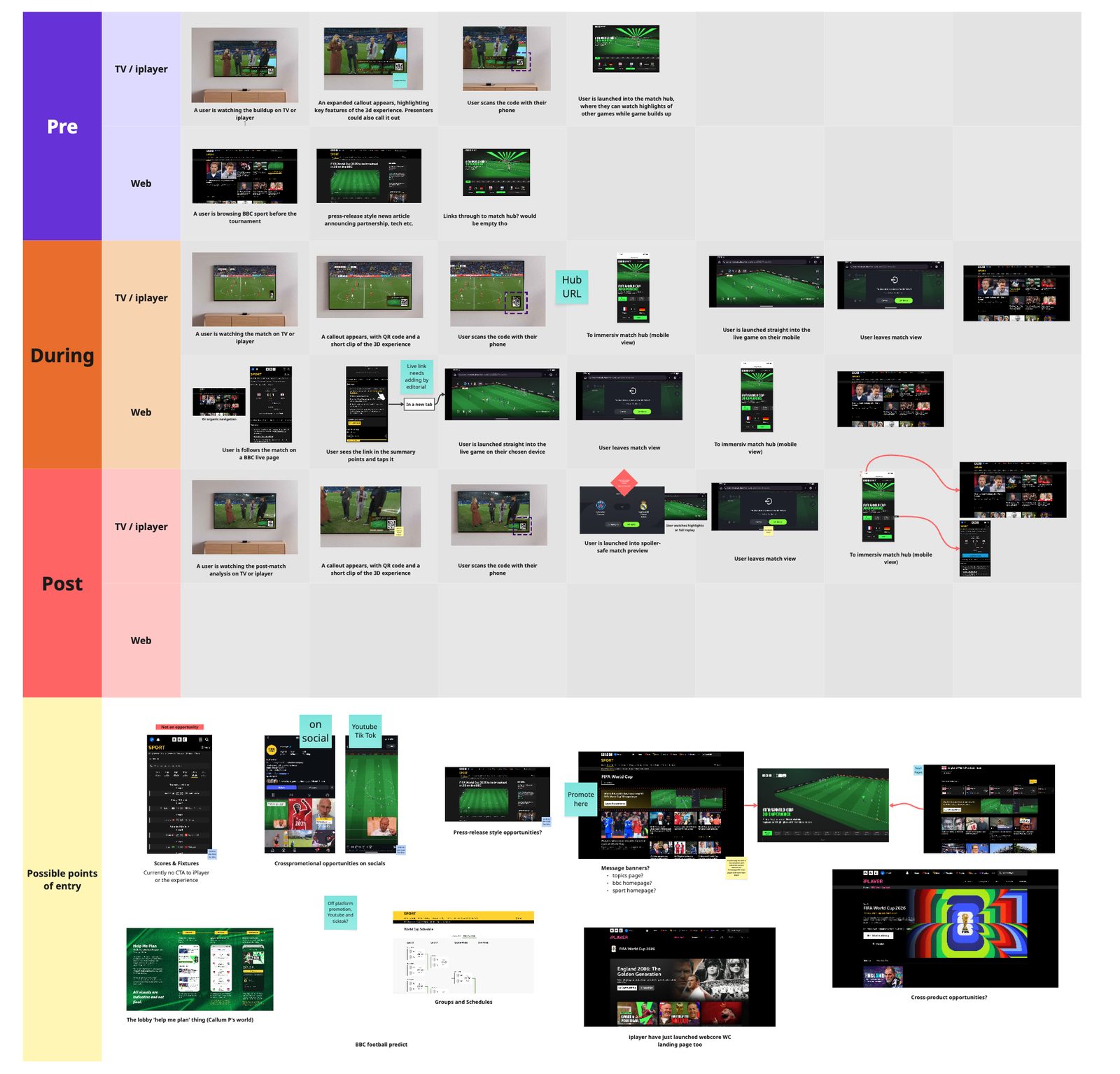
Together with the creative proposal, the journey map became the thing that joined everyone up. TV crews used it to plan QR code callouts during live match broadcasts. And through briefings based on the proposal, commentators had the words to explain the experience on air in a way fans would understand.
Then broadcast went one step further. During a hydration break in one match, they showed a replay of a goal from the 3D experience, live on air.
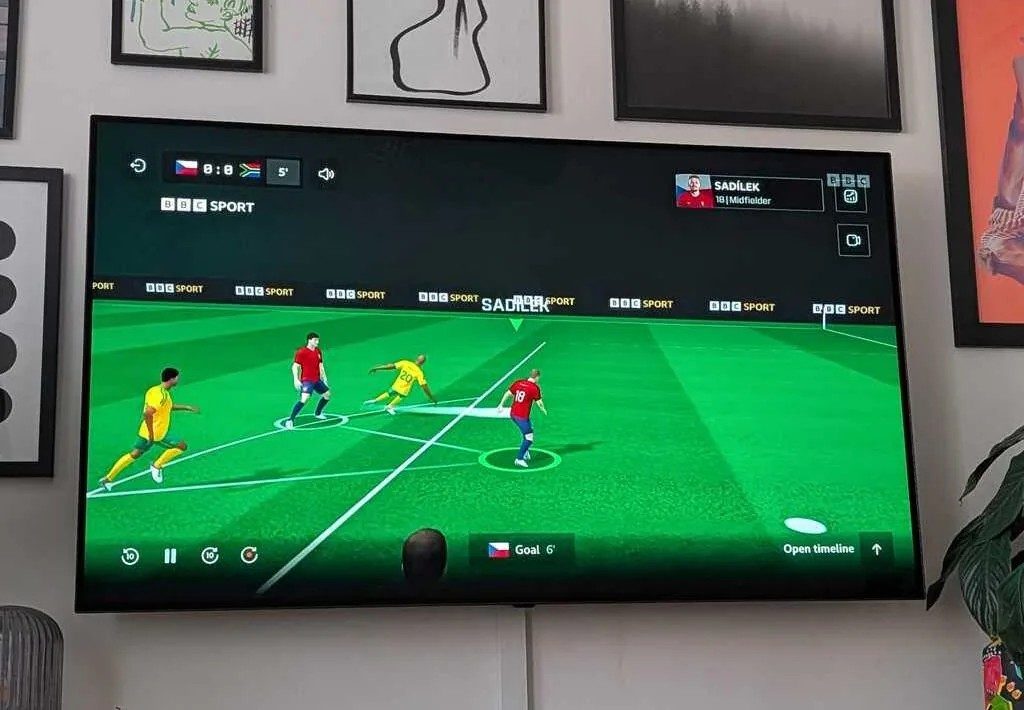
Fans didn't just watch. They took part
Once it launched, fans started doing things nobody had planned for.
Point-of-view and free-camera replays made moments rewatchable, and very shareable. Tactics, player positions and disputed incidents became something people could explore and argue about. What spread most wasn't whole matches but moments: goals, oddities, controversy and a player's-eye view.
Creators used the 3D recreations as raw material for their own videos and streams. One developer was curious enough to write a detailed blog post about how it worked.
The experience was meeting exactly the participation needs we'd been designing for: sharing an experience, having an opinion, talking to other fans and enjoying playful moments. There was just one problem. Almost all of it was happening on other platforms.
Bringing the conversation back to the BBC
We had nowhere on the BBC to show off what fans were making. So I designed one.
The Community concept added a second tab alongside Matches: a feed of the best fan clips, with the creator's own words about what they were watching and why. It turned fan creativity from something that happened elsewhere into part of the experience itself, with the potential to feed the best moments back into the match timeline.
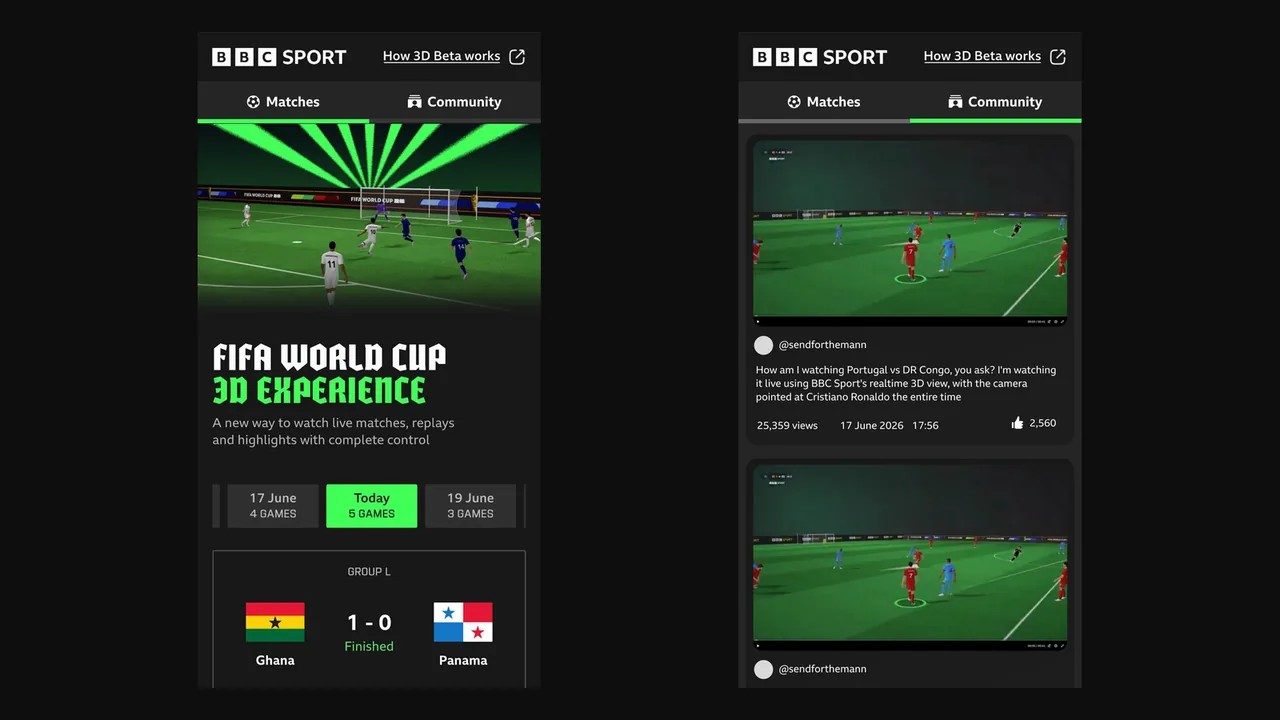
The concept sharpened a bigger question for our Live and Interactive work: how the BBC moves from a one-way publishing model to a participatory one, and which kinds of participation belong on our own platforms.
What it added up to
The beta reached far beyond a niche audience:
- around 5 million sessions, from almost 3 million people
- over 5 minutes spent on average
- a loyal core of fans coming back day after day
It worked for BBC Sport on air too. Presenters used it in the studio to talk through key moments, so one tool served both the broadcast and the audience at home.
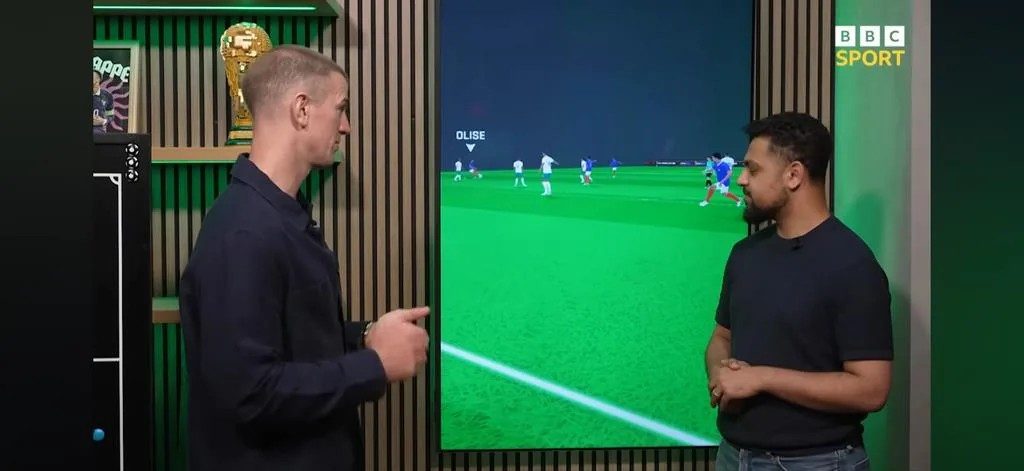
And people noticed. Fans didn't just praise a feature. Some held it up as an example of what public service innovation can look like.
Possibly the greatest invention of all time. BBC, take a bow.
A fan on X
This feels like the second-screen experience broadcasters have been chasing for years, except this one actually offers something new, fun and useful.
Creative Bloq
What I learned
We set out to give fans control of the camera. What they really wanted was control of the conversation.
The words mattered as much as the technology. Getting everyone, from TV crews to commentators, to describe it the same way is what got millions of people through the door. Once they were in, they took it somewhere we hadn't expected. The next design question is whether that somewhere is ours.